



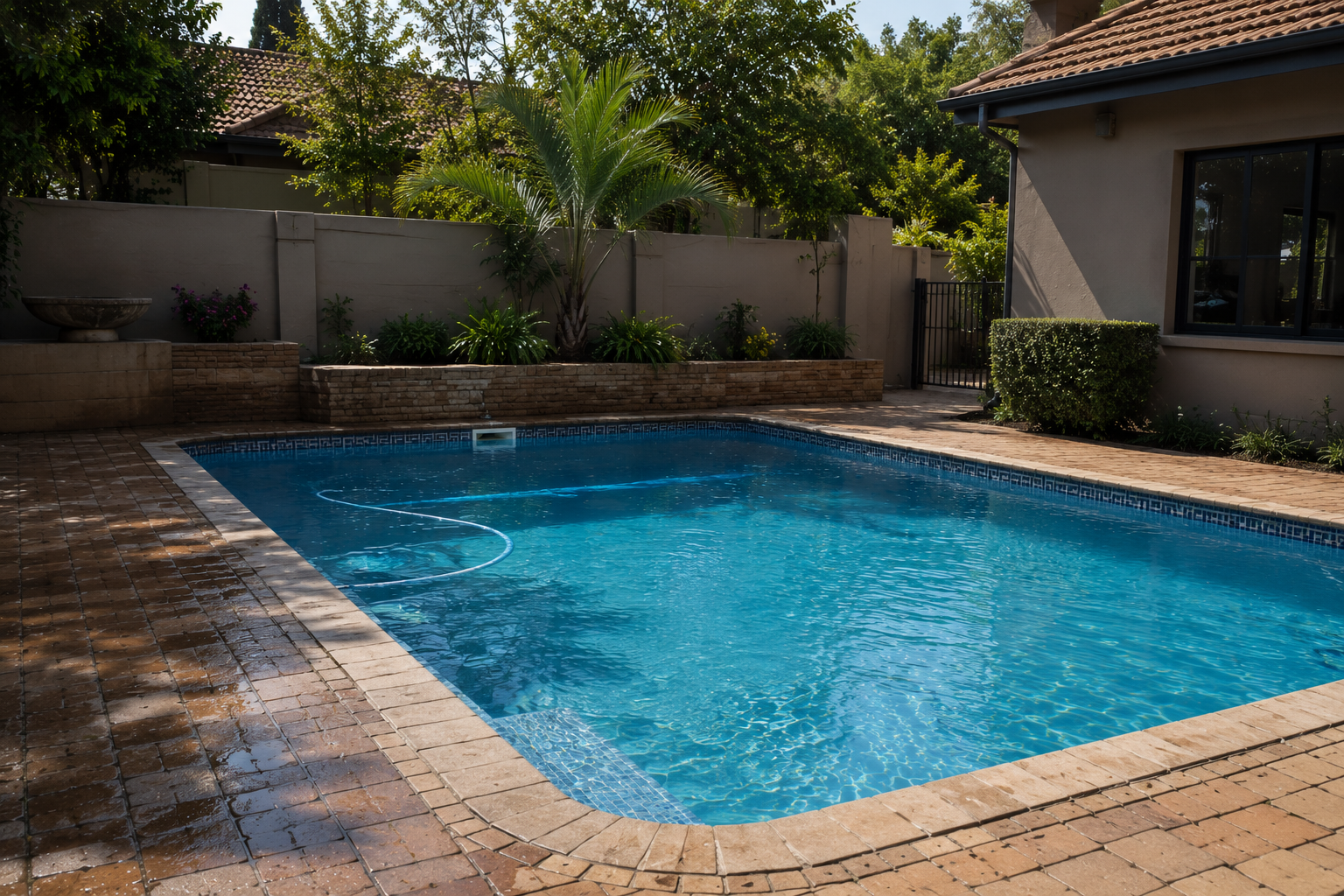
Owning a swimming pool means expecting a small amount of water loss from time to time. Hot summer days, wind, splashing, and regular use all contribute to evaporation, especially in Johannesburg’s warm climate. Because of this, many homeowners don’t immediately realise there’s a problem when the water level begins dropping.
The challenge is knowing when normal water loss becomes something more serious.
A swimming pool leak rarely announces itself with obvious damage. Instead, it often starts with small warning signs that become easier to notice over time. You may find yourself adding water more often than usual, noticing damp patches around the pool, or wondering why your water bill has suddenly increased. While these issues may seem minor at first, ignoring them can eventually lead to structural damage, expensive repairs, and unnecessary water wastage.
Learning how to recognise the early signs of a pool leak can help you act before the problem becomes more costly. Although some issues have simple explanations, others require professional leak detection to identify exactly where the water is escaping.
Concerned Your Pool Might Be Leaking?
Fill in the form below to speak with Absolute Pools about professional swimming pool leak detection and repairs in Johannesburg.
Not Every Drop in Water Level Means You Have a Leak
One of the biggest misconceptions among pool owners is believing that every drop in water level indicates a leak.
In reality, evaporation is completely normal.
During Johannesburg’s hot summers, a swimming pool can lose several millimetres of water each day through evaporation alone. Windy conditions, low humidity, direct sunlight, and heated pool water can all increase this natural water loss.
Before assuming the worst, it is important to consider recent weather conditions and how often the pool has been used. Children playing, frequent backwashing, and even vacuuming to waste can all lower the water level without indicating a leak.
Understanding what is considered normal water loss helps prevent unnecessary concern while making it easier to recognise when something genuinely isn’t right.
You’re Constantly Adding Water
One of the clearest signs of a potential leak is needing to top up the pool far more frequently than before.
Most homeowners become familiar with their pool’s normal water level over time. If you suddenly find yourself reaching for the hose every few days despite similar weather conditions, it’s worth investigating further.
Excessive water loss doesn’t always mean the leak is large.
Even a relatively small leak can result in thousands of litres of wasted water over the course of several weeks. Apart from increasing your municipal water bill, this constant loss places unnecessary strain on your pool equipment as water chemistry continually changes with every refill.
If topping up the pool has become part of your weekly routine without any obvious explanation, professional leak detection may be worthwhile.
The Bucket Test Can Help Confirm Your Suspicion
Before arranging professional leak detection, many homeowners perform a simple bucket test.
The test involves placing a bucket filled with pool water on one of the pool steps and marking both the water level inside the bucket and the pool’s water level outside the bucket.
After approximately twenty-four hours, compare the two levels.
If the pool water has dropped significantly more than the water inside the bucket, there is a reasonable chance that water is escaping somewhere other than through normal evaporation.
Although the bucket test cannot identify where the leak is located, it provides a useful indication of whether further investigation is necessary.
Damp Areas Around the Pool
Water escaping underground doesn’t always remain hidden.
One of the warning signs many homeowners overlook is the appearance of damp patches around the swimming pool, particularly where there has been no recent rain or irrigation.
Soft ground, consistently wet paving, sinking soil, or unexplained patches of unusually green grass may all indicate water escaping beneath the surface.
Over time, this moisture can affect surrounding paving, retaining walls, landscaping, and even nearby structures if left unresolved.
Because underground leaks are often difficult to locate visually, these subtle changes around the pool can provide valuable clues that something is wrong.
Professional Leak Detection Starts With the Right Diagnosis
Complete the form below to speak with Absolute Pools about identifying and repairing swimming pool leaks before they become more expensive.
Cracks May Be More Than Cosmetic
Not every crack causes a leak, but every crack deserves attention.
Hairline cracks sometimes develop naturally as swimming pools age, while larger cracks may result from ground movement or structural stress.
Although some cracks affect only the surface finish, others allow water to escape into the surrounding soil.
Attempting to determine the seriousness of a crack without professional assessment can be difficult because the visible damage often represents only part of the problem.
If you notice new cracks appearing alongside unusual water loss, both issues should be investigated together rather than treated as unrelated problems.
Your Pool Equipment Could Be Leaking
The swimming pool itself is not always responsible for water loss.
Sometimes the problem originates within the filtration system.
Leaks may develop around pumps, filters, multiport valves, pipe connections, chlorinators, or other equipment connected to the circulation system.
Small drips around equipment can easily go unnoticed, especially if the filtration area is rarely inspected.
Checking the equipment regularly for visible signs of moisture or water accumulation can help identify problems before they become larger repairs.
Professional inspections usually include both the pool structure and the associated equipment to ensure every possible source of water loss is considered.
Your Water Bill Suddenly Increases
Many homeowners first suspect a pool leak after receiving a higher-than-normal municipal water account.
If household water usage has remained relatively unchanged but your water bill continues increasing, your swimming pool may be contributing to the additional consumption.
While higher temperatures naturally increase evaporation, consistently high water usage over several months should never be ignored.
Monitoring both the pool’s water level and household water consumption together often provides useful clues that something requires further investigation.
Delaying Leak Repairs Can Become Expensive
A small leak rarely remains a small leak forever.
As water continues escaping beneath the surface, it may gradually affect the surrounding soil, paving, pool shell, and nearby structures.
What initially requires a relatively straightforward repair can eventually develop into a far more extensive renovation if ignored for too long.
Water loss also affects pool chemistry, requiring additional chemicals and more frequent balancing to maintain safe swimming conditions.
Addressing leaks early is often the most cost-effective approach because it limits both water loss and the likelihood of secondary damage developing elsewhere.
Professional Leak Detection Saves Time and Guesswork
Many pool leaks cannot be identified through visual inspection alone.
Professional leak detection uses specialised equipment and proven testing methods to locate the exact source of water loss without unnecessary excavation or guesswork.
Rather than replacing parts that may not actually be faulty, experienced technicians work systematically to determine whether the leak originates from the pool shell, plumbing, fittings, or filtration equipment.
Accurate diagnosis allows repairs to be completed efficiently while avoiding unnecessary disruption and additional expense.
Don’t Ignore the Early Warning Signs
A swimming pool leak is rarely something that improves on its own.
The sooner unusual water loss is investigated, the easier it is to identify the cause and prevent more extensive damage.
If your pool requires constant topping up, the water level drops unusually quickly, damp areas begin appearing around the pool, or your water bill continues increasing without explanation, arranging a professional inspection is a sensible next step.
Taking action early not only protects your swimming pool but also helps preserve your property while avoiding larger repair costs in the future.
Expert Swimming Pool Leak Detection in Johannesburg
Fill in the form below to speak with Absolute Pools about professional leak detection, accurate diagnosis, and reliable swimming pool repairs throughout Johannesburg.


Comments are closed