



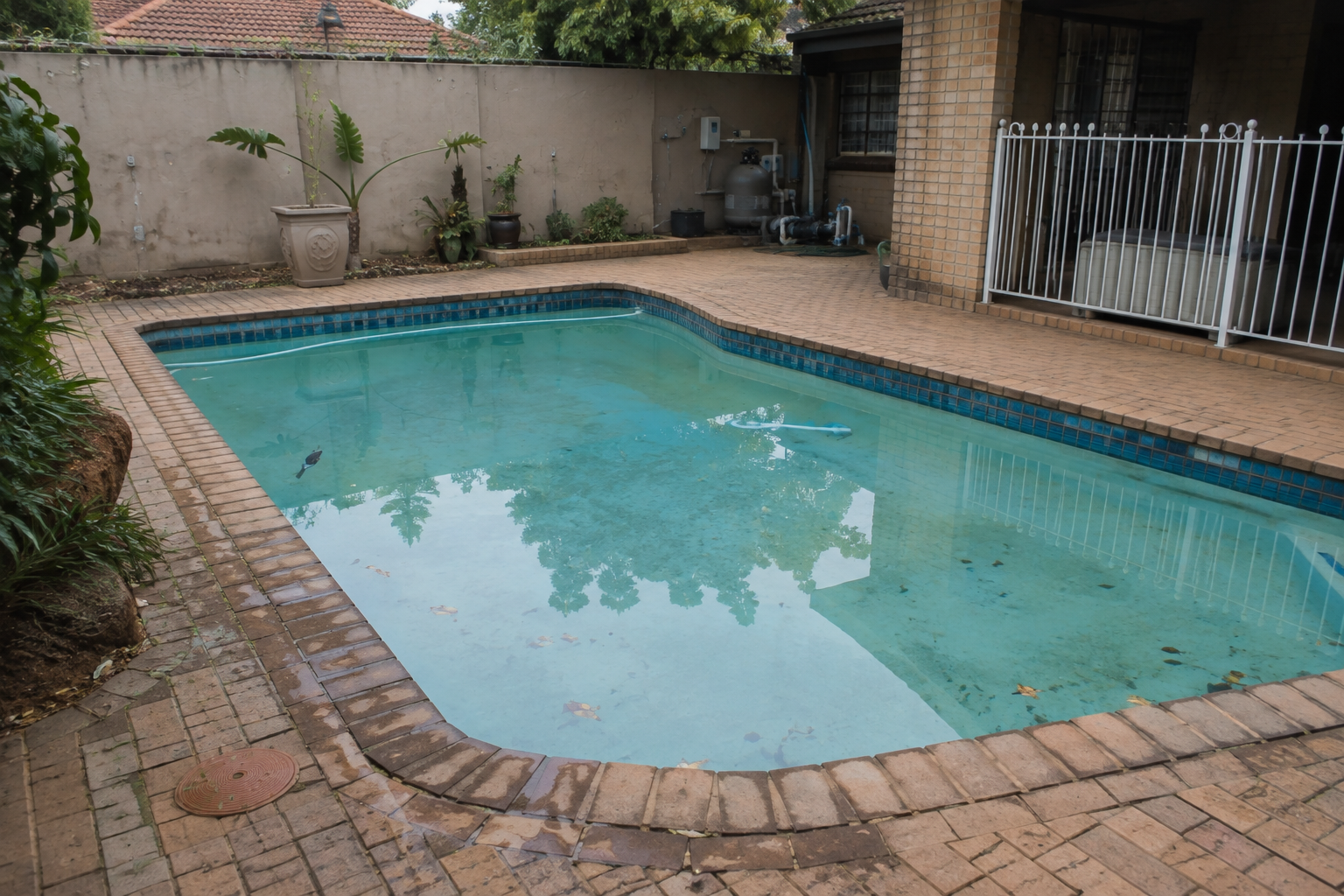
A swimming pool that keeps losing water can leave you wondering whether you’re dealing with ordinary evaporation or an actual leak.
Pretoria’s hot and dry weather can cause a noticeable amount of evaporation, particularly during the warmer months. Swimming, splashing, backwashing and general pool use can also lower the water level. But if you’re repeatedly adding water and the level continues to fall faster than expected, there could be a problem somewhere in the pool or its circulation system.
The frustrating part is that a leak isn’t always easy to find.
There might be an obvious crack in the pool surface, but there may also be no visible damage at all. Water can escape through a fitting, underground pipe, pool light, skimmer, main drain, pump connection or another part of the system. In some cases, the water travels beneath paving or into the surrounding soil, leaving very little evidence at the surface.
This is where professional leak detection can save a lot of unnecessary guesswork.
Request a Custom Quote
Fill in the form below to speak with Absolute Pools about your pool leak.
Estimated Pool Leak Detection Costs in Pretoria
For budgeting purposes, professional pool leak detection in Pretoria can be estimated at around R1,500 to R3,500, depending on the pool and how difficult the leak is to locate.
A relatively straightforward investigation may fall towards the lower end of that range, particularly where the suspected problem is accessible and there are clear signs pointing towards the source.
More complicated investigations can move towards the higher end where there are several possible leak points, underground plumbing or limited visible evidence.
These figures are estimated costs rather than a fixed Absolute Pools price. The actual cost of a particular job needs to be determined according to the pool, the suspected leak and the work required to locate it.
It is also important to understand that leak detection is not the same as leak repair.
The detection process establishes where the water is escaping. Once the source has been identified, the repair itself is assessed separately.
For example, finding a leaking fitting may result in a relatively simple repair. Finding a damaged underground pipe can involve accessing the affected section, repairing the pipe and potentially reinstating paving or another surface afterwards.
A cracked pool shell can be different again.
The estimated cost of detecting the leak may therefore be relatively straightforward, while the cost of fixing what has been found can range considerably depending on the underlying problem.
Estimated Pretoria Pool Leak Costs
| Service or problem | Estimated cost |
|---|---|
| Basic pool leak detection | R1,500 – R2,000 |
| More involved leak detection | R2,000 – R3,500+ |
| Accessible fitting or connection repair | From approximately R1,000+ |
| Underground pipe leak repair | Approximately R3,000 – R10,000+ |
| More extensive pool shell or structural repair | Can exceed R10,000 |
| Surface restoration or renovation following leak damage | Depends on pool size and scope |
These are planning estimates only. They should not be treated as a quotation for a specific Pretoria property.
The biggest variable is what the leak turns out to be.
Why Leak Detection Costs Differ From Pool to Pool
There is no single leak-detection job.
A small, straightforward pool with an obvious water-loss problem can be relatively simple to investigate. An older pool with several fittings, underground pipework and previous repairs may require considerably more investigation.
The pool’s size and design can also affect the process.
A basic rectangular pool with standard plumbing is different from a pool with multiple return lines, water features, lights, a built-in spa or other additional components.
The age of the pool can be important as well.
Older swimming pools often have older plumbing and fittings. Some may have been resurfaced or repaired several times over their lifetime, meaning there are more potential areas that need to be considered.
Then there is the surrounding property.
If the plumbing runs underneath paving, a patio or landscaped area, the leak may not be visible where it is actually occurring. Water can travel through soil or beneath hard surfaces before appearing somewhere else.
That makes it much more difficult to identify the source simply by looking for wet ground.
A proper leak investigation is therefore about narrowing down the possibilities rather than randomly opening areas of the property.
Is Your Pool Actually Leaking?
Before worrying about the cost of leak detection, the first question is whether the water loss is actually abnormal.
Swimming pools lose water naturally.
Evaporation can be significant during Pretoria’s hotter periods, particularly when the pool is exposed to direct sunlight and wind. A busy pool can also lose water through splashing and normal use.
The problem is when the loss becomes excessive or noticeably different from what you are accustomed to.
If you’re topping up the pool once in a while, there may not be a problem.
If you’re adding substantial amounts of water several times a week, it is worth investigating.
Other signs can make a leak more likely.
You may notice damp paving that doesn’t seem to dry, unusually wet soil beside the pool, a drop in water level that continues even when the pool isn’t being used, or water around the pump and filter.
The equipment can provide clues too.
A pump that repeatedly loses prime, air bubbles appearing from the return jets or unusual changes in suction can point towards a circulation problem that may involve a leak.
These signs don’t prove that a leak exists, but together they provide a good reason to investigate.
The Bucket Test Can Give You an Early Indication
You don’t necessarily need specialist equipment to get an initial idea of whether your pool is losing more water than evaporation would explain.
A bucket test can provide a useful comparison.
Place a bucket on one of the pool steps and add water until the water level inside the bucket is similar to the pool water outside it. Mark both levels.
Leave the pool for a period without adding water and then compare the change.
The bucket is exposed to the same weather conditions as the pool, so its water loss provides a rough indication of evaporation.
If the pool loses considerably more water than the bucket, there may be a leak.
It isn’t a definitive test and won’t tell you where the leak is located. Wind, temperature, pool use and other conditions can affect the result.
But it can help answer an important first question:
Is this likely to be more than ordinary evaporation?
If the answer appears to be yes, professional leak detection becomes much more worthwhile.
Where Do Pool Leaks Usually Come From?
There are several areas that can cause water loss.
The pool shell is an obvious possibility. Cracks or damaged sections can allow water to escape, although a visible crack isn’t automatically responsible for a leak.
Pool fittings are another potential source.
The weir, return fittings, main drain, lights and other penetrations through the pool structure all need to remain properly sealed.
Then there is the plumbing.
Underground pipes connect the pool to the pump and filtration system. If one of those pipes develops a leak, the water can disappear beneath the surface without leaving an obvious trail.
The equipment area needs attention too.
A leaking pump connection, valve, pipe joint or other fitting can cause water loss even when the pool itself is completely sound.
This is why leak detection needs to look at the pool as a complete system.
Absolute Pools identifies the pool shell, pipework, fittings, suction and return lines, lights and equipment connections as possible sources of pool leaks.
Underground Plumbing Leaks Can Be More Complicated
An underground leak is one of the situations where professional detection can be particularly valuable.
The pipe might run beneath a paved area, garden, driveway or patio.
If you simply start digging where you notice dampness, you could easily open the wrong section.
Water doesn’t always travel vertically from the point where it escapes. It can move through soil and along other pathways before appearing at the surface.
This means the wet patch may be several metres away from the damaged pipe.
Underground leaks can also be slow.
You may not see a large amount of water escaping at once. Instead, the pool gradually loses water over several days, and the only obvious symptom is that the water level keeps dropping.
Locating the problem before excavating can reduce unnecessary disruption to the property.
It also means the eventual repair can be planned around the actual location of the damaged section rather than relying on guesswork.
How Much Does an Underground Pool Leak Repair Cost?
Once the leak has been located, the repair cost depends on what needs to be done.
For a relatively accessible plumbing repair, the cost may be manageable.
Underground plumbing can be more expensive because there are several components to the job.
The affected area needs to be accessed.
The damaged pipe or connection needs to be repaired.
The system needs to be tested again.
Then any paving, soil or other surface disturbed during the repair may need to be reinstated.
For budgeting purposes, an underground pool plumbing repair can potentially fall somewhere around R3,000 to R10,000 or more, depending heavily on the location and extent of the damage.
That is why it isn’t useful to quote a single figure without seeing the property.
A pipe under a small garden bed is a different job from a damaged line beneath a large paved entertainment area.
The detection process helps establish which situation you’re dealing with.
Pool Shell Leaks Are Different From Plumbing Leaks
A pool can lose water through its actual structure rather than its plumbing.
This may happen because of a crack or deterioration in the pool shell or interior surface.
The repair required depends on the type and extent of the damage.
A localised issue may be repaired without renovating the entire pool.
But an older pool with widespread cracking, deteriorated marbelite or repeated surface repairs may need a more comprehensive solution.
That is where leak detection can uncover a bigger conversation about the condition of the pool.
If the pool has already reached the stage where the surface is badly worn, repeatedly repairing individual leaks may not be the most sensible long-term approach.
Resurfacing, re-marbelite or fibreglass relining may be considered depending on the construction and condition of the pool.
Absolute Pools provides pool resurfacing, re-marbelite, relining and fibreglass repair services as part of its wider pool repair and renovation work.
The important point is not to assume that every leak requires a full renovation.
The condition of the pool needs to determine the solution.
Get Your Pool Leak Assessed
Fill in the form below to speak with Absolute Pools about finding the source of the water loss.
Could Your Pool Equipment Be Causing the Water Loss?
Yes.
Sometimes the pool itself isn’t leaking at all.
The problem can be somewhere around the pump, filter or plumbing connections.
A leaking seal or pipe connection can release water around the equipment area. A damaged valve or fitting can do the same.
The pump can also provide clues.
If it repeatedly loses prime or struggles to maintain normal circulation, there could be air entering the system through a suction-side problem.
If water is collecting around the equipment, the source should be investigated rather than assuming that the pool shell is leaking.
Absolute Pools also provides pool equipment repairs, including pump, filter and chlorinator repairs, so equipment-related problems can be assessed alongside suspected pool leaks.
This matters because replacing or repairing the wrong component won’t solve the water-loss problem.
Can a Pool Light Cause a Leak?
Pool lights are another potential source of water loss because they are installed through the pool structure.
The fitting needs to be properly sealed.
If that seal deteriorates or the area around the fitting becomes damaged, water can potentially escape.
The problem may not be obvious from outside the pool.
There may be no large crack or wet area around the pool deck. Instead, the water simply continues disappearing.
This is why fittings need to be considered when investigating a pool that is losing water without an obvious source.
The same principle applies to the weir, return jets, suction points and main drain.
A pool contains several points where components pass through or connect to the structure, and each one needs to be considered when the source of water loss isn’t immediately apparent.
Why the Water Level Can Tell You Something
The level at which a pool stops losing water can sometimes provide a useful clue.
For example, if the water level continues dropping but eventually stabilises around the height of a particular fitting, that fitting or nearby area may deserve attention.
This isn’t proof of a leak location.
Water can behave differently depending on the pool’s construction and plumbing, and there may be more than one leak.
But observing the pattern can provide useful information.
It is worth noting when you first noticed the problem, how quickly the water level drops and whether the pool behaves differently when the pump is operating.
These details can make the initial assessment more productive.
What Happens During Professional Pool Leak Detection?
A leak investigation should begin with the symptoms rather than immediately assuming where the problem is.
The technician can look at the rate of water loss, the pool’s construction, visible cracks, fittings, equipment and circulation system.
If there are signs pointing towards underground plumbing, that area can be investigated further.
Different leak-detection techniques may be appropriate depending on the situation.
Dye testing can help with certain visible or suspected leaks around fittings.
Pressure testing can help assess plumbing lines.
Specialist detection equipment may also be used where the leak is hidden and difficult to locate through visual inspection.
The objective isn’t simply to confirm that the pool is losing water.
You already know that if you’re filling it repeatedly.
The useful result is narrowing down where the water is escaping so that the repair can be targeted.
Why Finding the Leak Before Repairing It Matters
Imagine you have a wet patch beside the pool.
You assume the pipe underneath it is leaking, so you remove the paving.
The pipe is fine.
Now you’ve paid to remove and reinstate the paving without solving the original problem.
Or perhaps you see a crack in the pool and assume that it is responsible for the water loss. You repair the crack, refill the pool and discover that the water is still disappearing.
The problem was somewhere else.
This is exactly why detection comes before major repair work.
It reduces the amount of guesswork.
It also makes it easier to decide whether the repair is localised or whether there is a larger issue that needs attention.
For expensive paving, landscaping or recently renovated pool areas, avoiding unnecessary disturbance can be particularly valuable.
Does Pretoria Weather Affect Pool Leak Detection?
Pretoria’s climate can make water loss more noticeable.
Hot weather increases evaporation, while dry conditions can make it difficult to distinguish between natural water loss and a genuine leak.
Wind can also increase evaporation from an exposed pool.
This is one reason it is useful to look at the pattern over time rather than reacting to a single drop in water level.
If the pool loses a little water during a particularly hot and windy week, that may be completely normal.
If it continues losing significant amounts of water regardless of weather and pool use, the situation deserves closer attention.
The weather should be considered when assessing water loss, but it shouldn’t become an excuse to ignore persistent problems.
When Should You Call for Pool Leak Detection?
You don’t necessarily need professional detection every time the pool level drops.
But there are several situations where it makes sense.
If you are repeatedly topping up the pool, that’s one.
If the pool loses water much faster than expected, that’s another.
Persistent damp areas around the pool, unexplained wet soil or water around the equipment are also worth investigating.
The same applies when the pump loses prime, circulation changes or you see unusual air bubbles coming through the returns.
A visible crack combined with ongoing water loss deserves attention too.
The longer you spend trying random fixes, the more difficult it can become to know which change actually affected the problem.
Professional detection gives you a starting point based on evidence rather than assumptions.
What Is Included in the Cost of Leak Detection?
This is a useful question to ask before arranging an appointment.
The exact inclusions depend on the service required, but you should understand whether the quoted amount covers the initial assessment, detection work and identification of the likely source.
You should also establish whether repairs are charged separately.
In most cases, they should be considered separate because the repair cannot be accurately priced until the cause and location of the leak are known.
For example, detecting a leak may reveal a damaged underground pipe.
At that point, the repair quotation can account for the location, access requirements and extent of the damage.
Alternatively, detection may reveal that the problem is an accessible fitting that requires a much simpler repair.
The point is that the detection cost gives you information.
It isn’t necessarily the final cost of getting the pool back to normal.
Why Absolute Pools Is a Go-To Option for Pool Leak Detection in Pretoria
Absolute Pools provides pool leak detection and repair services in Pretoria, with pool repair work covering a range of problems including leaks, cracks, resurfacing, re-marbelite, relining and fibreglass repairs.
That broader experience is useful when a leak turns out to be connected to another part of the pool.
A pool may be losing water because of an underground pipe.
It may be a fitting.
It may be the equipment.
Or the leak may be one symptom of a pool surface that has deteriorated over many years.
Absolute Pools also handles pool equipment repairs, including pumps, filters and chlorinators, allowing equipment-related problems to be considered when investigating water loss.
That means the focus can remain on identifying the actual problem rather than assuming that every leaking pool needs the same repair.
Don’t Keep Filling the Pool Without Finding the Cause
Adding water may keep the pool usable temporarily, but it doesn’t solve the reason the water is disappearing.
If the loss is simply evaporation, there may be nothing to repair.
If there is a genuine leak, however, continuing to top up the pool can become an ongoing expense while the underlying problem remains.
The cost of professional leak detection is generally much easier to budget for than an unnecessary excavation or a series of repairs carried out in the wrong places.
More importantly, once the source is identified, you have a much clearer idea of what happens next.
It could be a small fitting repair.
It could be equipment work.
It could involve underground plumbing.
Or it could reveal that the pool surface itself needs more attention.
The estimated cost of pool leak detection in Pretoria can therefore be thought of as the first step towards understanding the actual repair cost.
Get Your Pool Leak Assessed
Fill in the form below to speak with Absolute Pools about locating and repairing your pool leak.

Comments are closed