



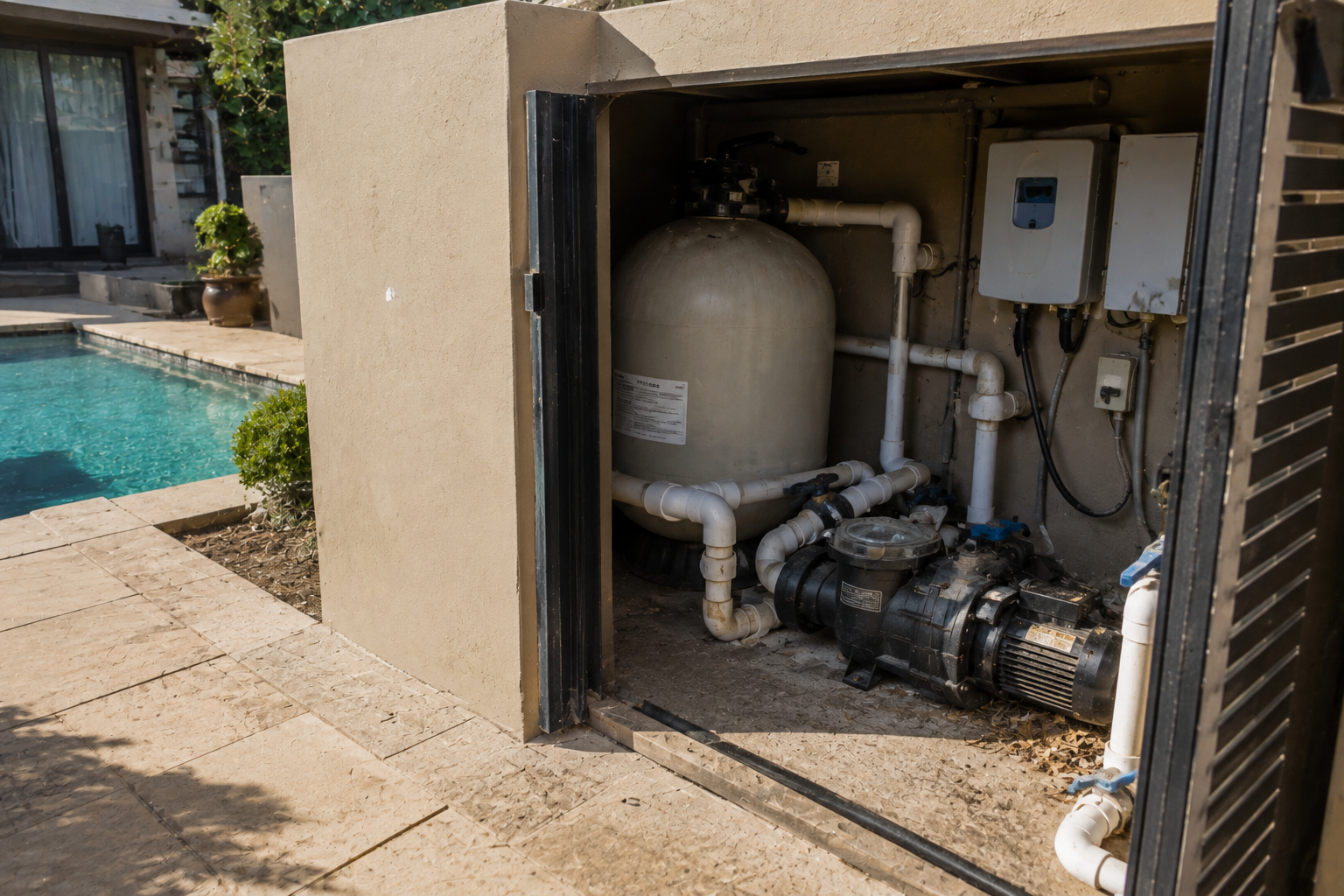
A swimming pool can look perfectly healthy while the equipment keeping it running is starting to struggle.
You may notice that the water isn’t circulating as strongly as it used to, the pump has become unusually noisy, the filter pressure keeps climbing, or the pool takes much longer to clear after rain or heavy use.Â
Sometimes the warning is even less obvious. The equipment still switches on, but the pool just doesn’t seem to stay as clean and clear as it normally does.
These are all signs worth paying attention to.
The pump, filter and chlorination system are responsible for much of what happens behind the scenes. They keep water moving, remove debris and help maintain the conditions needed for a clean and usable pool. When one component starts failing, it can put additional pressure on the rest of the system.
The good news is that equipment problems don’t always mean the entire system needs to be replaced. A worn seal, blocked component, electrical fault, damaged impeller or problem with a connection may be repairable.Â
On the other hand, older equipment that has become unreliable may be more cost-effective to replace.
The first step is finding out what has actually gone wrong.
Get Help With Your Pool Equipment
Fill in the form below to speak with Absolute Pools about your pool equipment repair.
What Equipment Does a Swimming Pool Need?
A swimming pool relies on several pieces of equipment working together to keep the water moving and clean.
The pump is at the centre of the circulation system. It draws water from the pool and pushes it through the filtration system before returning it to the pool.Â
Without adequate circulation, the rest of the system cannot perform properly.
The filter has a different job. It removes suspended dirt and debris from the water as the water passes through it. Depending on the system installed, this may be a sand filter, cartridge filter or another filtration setup.
Then there is the chlorination system. A salt-water chlorinator, for example, uses salt dissolved in the pool water to produce chlorine. Other pools may rely on different forms of chlorine treatment.
Around these major components are smaller parts that are just as important to the system. Valves, seals, pressure gauges, baskets, unions, pipes, electrical connections and control components can all develop problems.
That means a pool equipment repair isn’t necessarily about repairing the biggest piece of equipment you can see.
A pump that isn’t circulating properly could have a problem with the motor, impeller, seal, basket or suction side of the system.Â
A filter that isn’t performing may have an issue with its internal components, pressure, valve or maintenance.Â
A chlorinator that isn’t producing enough chlorine could have a problem with the cell or control system, but there may also be another reason for the poor performance.
The equipment needs to be considered as a complete system.
That is especially important when a problem has been occurring for some time. Fixing the most obvious symptom without finding the underlying cause can leave the pool owner dealing with the same problem again.
Signs That Your Pool Equipment Needs Attention
Pool equipment rarely fails without giving some warning.
Sometimes the warning is obvious, such as a pump that refuses to start. Other times, it appears as a gradual change in how the pool behaves.
One of the easiest signs to notice is a change in the pump’s sound. You become accustomed to the normal hum of your equipment, so a sudden grinding, rattling, squealing or vibrating sound is worth investigating.
Water flow is another useful indicator. Look at the return jets when the circulation system is running. If the flow is noticeably weaker than usual, something may be restricting circulation or the pump may no longer be operating as it should.
The pool itself can also tell you that something is wrong.
If the water stays cloudy despite normal cleaning and chemical treatment, the filtration system may not be doing its job effectively.Â
If debris seems to remain suspended in the water for longer than usual, circulation could be inadequate.
Repeated algae growth can also be a warning that something needs checking. Algae can obviously have several causes, including poor chemical balance, but inadequate circulation can make the problem much harder to control.
Water around the equipment pad is another sign that shouldn’t be ignored. A persistent leak could come from a seal, pipe connection, valve, union or another component.
Then there are electrical symptoms. A pump that trips the circuit, struggles to start or switches itself off may need urgent attention rather than repeated attempts to restart it.
None of these symptoms identifies the exact fault on its own. They are clues that the equipment needs to be assessed.
Pool Pump Repairs in Sandton
The pump is usually the first piece of equipment people think about when they hear the words “pool equipment repair”, and for good reason.
It is constantly working to move water through the system, and a problem with the pump can quickly affect the rest of the pool.
A pump that is making unusual noises may have a mechanical problem. Bearings can wear, seals can deteriorate and internal components can become damaged. Debris can also interfere with the impeller and restrict the movement of water.
A pump can also struggle because of a problem elsewhere in the circulation system.
If air is entering the suction line, for example, the pump may have difficulty maintaining its prime. If there is a restriction in the plumbing or an obstruction in the basket, water flow can be affected before it even reaches the pump.
This is why simply replacing a pump isn’t always the answer.
The pump may be perfectly capable of continuing to operate once the actual cause of the problem has been corrected.
Leaks around the pump are another common concern. The pump contains seals and connections that need to keep water where it belongs.Â
When one of these deteriorates, water may begin appearing around the equipment.
Leaving a leaking pump unattended isn’t ideal. Water and electrical equipment should always be treated carefully, and a small leak can also develop into a more significant equipment or property problem.
Why Is My Pool Pump Making a Loud Noise?
A pool pump naturally makes some noise when it operates, but a sudden change in sound deserves attention.
A grinding noise can indicate wear within the motor or another mechanical component. A rattling sound may suggest something has become loose or that debris is interfering with the pump.Â
Excessive vibration can also point towards a mechanical or installation problem.
There are less obvious causes too.
The pump may be struggling because it isn’t receiving enough water. It may have lost its prime, have air entering the suction system, or be working against a restriction.
That distinction matters.
Replacing an expensive component without checking the circulation system first can result in unnecessary expenditure while leaving the original problem unresolved.
A pump that has gradually become louder over several months may also be telling you something different from a pump that suddenly started making noise yesterday.
The timing, sound and other symptoms all provide useful information when diagnosing the fault.
If your pump is still running despite the noise, it can be tempting to leave it alone because the pool is technically still circulating. But continued operation can place additional strain on already-worn components.
Getting the problem checked earlier can sometimes mean dealing with a repair rather than waiting for a complete failure.
Why Is My Pool Pump Not Circulating Water Properly?
Poor circulation can have several causes, and the pump isn’t necessarily the culprit.
The first thing to consider is whether the pump is receiving enough water. A low water level in the pool, blocked baskets, suction restrictions or air entering the system can all affect the amount of water reaching the pump.
The pump itself can also be responsible.
An impeller that is blocked or damaged won’t move water as effectively. Internal wear can affect performance, while electrical or motor problems may prevent the pump from reaching normal operating performance.
The filter can also contribute.
A heavily restricted filter can increase resistance within the system, affecting how efficiently water moves through the circulation circuit.
This is why poor circulation is best approached as a system problem rather than immediately blaming one component.
Once the cause has been identified, the appropriate repair becomes much clearer.
Filter Repairs Can Make a Big Difference to Water Quality
A swimming pool filter has a fairly simple job: water passes through it and unwanted particles are removed.
But when the filter isn’t working correctly, the effects can become very noticeable.
Water may remain cloudy, fine particles may continue circulating and the pool may take much longer to recover after heavy use or environmental contamination.
High filter pressure is one of the signs that something has changed. Depending on the filtration system, the solution may involve cleaning, backwashing or inspecting the filter for a deeper problem.
Sand filters require different care from cartridge filters, and the equipment should be serviced according to the type of system installed.
A filter can also develop internal problems. Components inside the filter can become damaged or worn, while valves and seals can deteriorate over time.
If a filter is repeatedly causing problems, it may be worth assessing its overall condition rather than repairing the same issue over and over again.
Age is a factor, but it isn’t the only one.
The size of the pool, the pump, the filter capacity and the way the system is being used all influence whether the equipment is still appropriate for the pool.
High Filter Pressure: What Does It Mean?
A pressure gauge can provide an early warning that something is happening inside the filtration system.
If the pressure is higher than what is normal for your particular setup, the filter may be struggling to allow water to pass through it.
A dirty filter is one possible cause.
But it isn’t the only explanation.
There could be a restriction in the return system, a valve problem or another issue affecting water movement.
This is why simply opening the filter and cleaning it isn’t always enough.
If the pressure keeps returning to an unusually high level shortly after cleaning, there may be an underlying issue that needs further investigation.
The normal pressure for one pool isn’t necessarily the same as the normal pressure for another. What matters is a noticeable change from the system’s usual operating condition.
Keeping an eye on the gauge can therefore be surprisingly useful, particularly if you know what your normal reading looks like.
Chlorinator Repairs and Problems With Chlorine Production
Salt-water chlorinators have become common in residential pools because they provide a convenient way of generating chlorine as part of the pool’s circulation system.
When the chlorinator isn’t functioning correctly, the first sign may simply be that the chlorine level isn’t being maintained as expected.
But before assuming that the chlorinator has failed, the wider system needs to be considered.
The cell can accumulate deposits, electrical connections can develop problems and the control unit can malfunction. Water chemistry can also affect how effectively the system operates.
A chlorinator that is producing less chlorine than it used to may therefore need cleaning, servicing or repair rather than immediate replacement.
The age of the cell matters as well. Chlorinator cells have a finite working life, and eventually replacement becomes more practical than continued repair.
Getting the actual cause identified helps prevent unnecessary expenditure.
Water Around Your Pool Equipment Shouldn’t Be Ignored
A wet equipment area isn’t something to dismiss as normal.
There are several places where water can escape around pool equipment, including pipe connections, seals, valves and pump components.
Sometimes the leak is small enough to go unnoticed for a while. You may simply see dampness on the ground or notice that the area never seems to dry properly.
Other leaks are much more obvious.
The concern isn’t only the water being lost. Persistent leaks can affect the equipment itself and the surrounding area.
If the pool is also losing water, it can become difficult to determine whether the water is escaping from the pool shell, plumbing or equipment unless the system is properly checked.
That is where leak detection becomes useful.
A swimming pool can lose water through the shell, underground pipework, fittings, lights and other areas, so the source needs to be identified before the correct repair can be selected.
When Does a Pool Equipment Problem Become Urgent?
Not every equipment fault requires the same level of urgency.
A slightly noisy pump that is still circulating correctly is different from a pump that is overheating, leaking heavily or repeatedly tripping the electrical supply.
Likewise, a filter that needs routine cleaning is different from one with a damaged component that is preventing proper filtration.
Some warning signs should not be ignored.
Electrical problems deserve particular care because swimming pool equipment combines electricity and water. A pump that repeatedly trips a circuit or shows signs of an electrical fault shouldn’t simply be switched back on repeatedly in the hope that it will start working normally.
Significant water leaks should also be dealt with promptly.
The longer equipment operates under abnormal conditions, the greater the chance that a relatively contained problem can affect other components.
Getting advice early doesn’t necessarily mean an expensive repair. It simply means you find out what you’re dealing with before the situation becomes more complicated.
Repair or Replace? How to Make the Right Decision
There is a point where repairing old equipment no longer makes financial sense.
But reaching that point isn’t determined by age alone.
A pump that is several years old might still be in good condition apart from one replaceable component. Repairing it could be perfectly sensible.
An older pump that has already needed several repairs, is becoming unreliable and is becoming increasingly expensive to maintain may be a different story.
The same applies to filters and chlorinators.
The cost of the repair should be considered alongside the condition of the equipment, availability of parts, expected reliability and efficiency.
There is also the question of whether the existing equipment is correctly sized for the pool.
If a pump has always struggled to circulate the water adequately, replacing it with another pump of the same specification may simply reproduce the problem.
A proper assessment can determine whether repair, replacement or a change to the overall equipment setup makes the most sense.
The cheapest immediate option isn’t necessarily the cheapest over the next several years.
Why Equipment Problems Sometimes Look Like Pool Problems
This is one of the reasons pool maintenance can become frustrating.
A pool owner sees cloudy water and assumes the chemicals are wrong. They add more chemicals, clean the pool and wait.
The water improves temporarily but becomes cloudy again.
The actual problem may be inadequate circulation or filtration.
The same can happen with algae. If water isn’t circulating effectively, some areas of the pool may receive less treated water than others. This can make algae much harder to control.
Even water loss can be misleading.
A leak around the equipment can look like a problem with the pool itself, while a leak in underground plumbing may not be visible anywhere around the equipment.
The mechanical system and the pool are connected.
When something changes, it is worth considering the whole system rather than focusing exclusively on the most obvious symptom.
Pool Equipment Maintenance Can Prevent Bigger Repairs
Repairs are sometimes unavoidable, but regular attention can help identify developing problems earlier.
The pump basket should be kept clear of debris. Filters need to be maintained according to their type. Pressure readings should be watched for unusual changes, and the equipment area should be checked for signs of water leakage.
The sound of the pump is worth noticing too.
If it suddenly sounds different, don’t assume the change is harmless simply because the pump is still running.
Regular pool maintenance also helps the equipment operate under the conditions it was designed for. Poor water chemistry, excessive debris and neglected filtration can all place unnecessary demands on the system.
Maintenance doesn’t mean taking apart equipment yourself.
In fact, electrical components and pressurised filtration systems are not areas where trial-and-error repairs are a good idea.Â
A qualified pool technician can inspect the system and determine what actually requires attention.
What Happens During a Professional Pool Equipment Repair?
A proper repair starts with diagnosis.
The technician needs to establish what the equipment is doing, what it should be doing and where the difference is coming from.
That may involve inspecting the pump, checking water flow, looking at connections, assessing the filter, examining valves and investigating the chlorination system.
The visible symptom isn’t necessarily where the problem originates.
Once the cause has been identified, the repair can be approached accordingly.
A worn or damaged component may be replaced. A blockage may be cleared. A seal may need attention. An electrical fault may require specialist repair. In other cases, the equipment may be reaching the end of its useful life and replacement may be recommended.
The important part is that the recommendation should follow the diagnosis.
You don’t want to replace an entire pump because of a problem that could have been solved with a much smaller repair. At the same time, repeatedly repairing equipment that has become unreliable doesn’t necessarily represent good value.
Pool Equipment Repairs as Part of a Larger Pool Renovation
Sometimes equipment problems appear at the same time as other signs that a pool is ageing.
The pump may be old. The filter may be struggling. The interior surface may be worn. The coping may be cracked and the pool may also be losing water.
At that stage, it can make sense to look at the entire pool rather than treating every issue separately.
Absolute Pools works across pool repairs and renovations, including equipment repairs, resurfacing, re-marbelite, fibreglass relining, fibreglass repairs and leak repairs. That means an equipment problem can be considered alongside the condition of the pool itself when a larger renovation is being planned.
Sometimes the equipment simply needs repairing and nothing else needs to change.
Other times, the equipment is one of several components that have reached the end of their useful life.
The right approach depends on the pool in front of you.
Get Your Pool Equipment Checked
Fill in the form below to speak with Absolute Pools about your pump, filter or chlorinator.
Why Absolute Pools Is a Go-To Choice for Pool Equipment Repairs in Sandton
Absolute Pools provides pool equipment repairs as part of its wider pool repair and renovation services, including work on pumps, filters and chlorinators.Â
The company also handles pool leaks, fibreglass repairs, resurfacing, re-marbelite and relining, giving you somewhere to turn when an equipment problem is happening alongside a larger pool issue.
That broader experience matters because pool equipment doesn’t work independently.
A pump problem can affect filtration. Filtration problems can affect water quality. A chlorinator fault can make maintaining the correct chlorine level more difficult. A leak in the circulation system can affect water levels and pump performance.
Looking at the complete system makes it easier to identify the actual source of the problem.
Absolute Pools serves Sandton and surrounding Johannesburg areas, providing repair and renovation services for pools that need anything from a specific equipment repair to more extensive restoration work.
The aim is to determine what the pool actually needs rather than automatically replacing equipment that may still have plenty of useful life left.
Don’t Wait Until the Pump Stops Completely
Pool equipment is easy to forget about when everything is working.
The pump runs, the filter does its job, the chlorinator maintains the water and the pool stays clean. There isn’t much reason to think about any of it.
That changes quickly when something starts going wrong.
A pump becomes noisy. Water flow weakens. Filter pressure changes. The water refuses to clear. Chlorine levels become difficult to maintain. Water appears around the equipment.
Those signs are worth investigating before a minor fault becomes a complete equipment failure.
Sometimes the solution is a straightforward repair. Sometimes replacement is the better long-term decision. And occasionally, the equipment is fine and the real problem lies somewhere else in the pool’s circulation system.
The only way to know is to diagnose the problem properly.
For a swimming pool in Sandton, keeping the equipment in good working order isn’t just about avoiding an inconvenient breakdown.Â
It helps the entire pool system operate properly, keeps maintenance manageable and protects the investment you’ve already made in your pool.
Start Your Pool Equipment Repair in Sandton
Fill in the form below to speak with Absolute Pools and get your pool equipment problem assessed.


Comments are closed